Yves Washington · 10 September 2026
Caleno's Ceramic Traditions Illuminate Ancient Trade Networks Across the Region
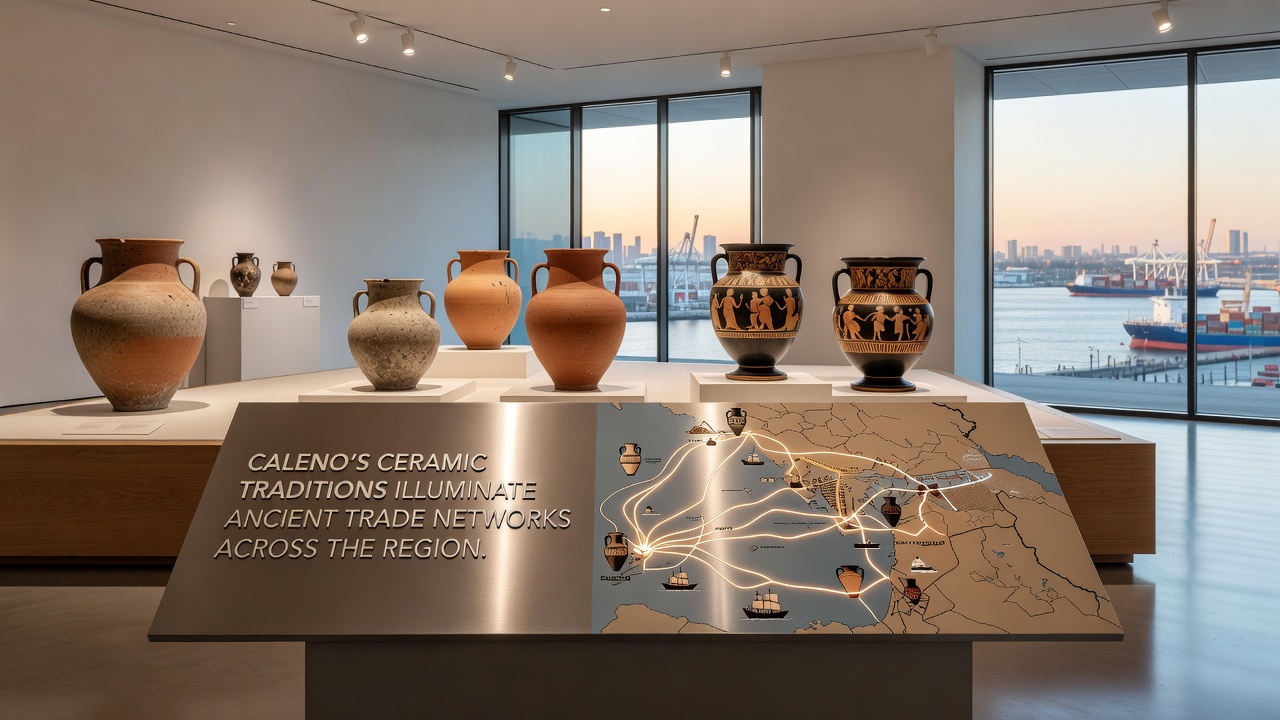
Caleno ceramic traditions have long served as key markers for mapping prehistoric exchange routes that connected inland settlements with coastal ports and distant inland communities throughout the broader region, and archaeologists continue to trace these connections through compositional analysis of clay bodies alongside decorative motifs that recur across multiple sites. Excavations conducted over the past decade have recovered thousands of sherds whose mineral signatures match clay sources located hundreds of kilometers away, which indicates regular movement of both raw materials and finished vessels along established pathways. Those pathways appear to have operated in both directions, because researchers have identified Caleno-style geometric incising on pottery recovered from harbor sites that also yielded imported obsidian and metal tools. Such bidirectional flows suggest that local potters adapted foreign techniques while simultaneously exporting distinctive wares that carried cultural information as well as practical utility. Radiocarbon dates cluster between the late Bronze Age and early Iron Age, placing the height of these exchanges several centuries before written records began in the area.Clay Sourcing and Technological Exchange
Petrographic studies performed at regional laboratories show that Caleno potters mixed local marls with temper derived from volcanic deposits located to the north, and the same temper appears in vessels found at sites well beyond the immediate river valleys. This shared resource use points to coordinated procurement networks rather than isolated production, and it aligns with settlement patterns that placed workshops near natural fords and seasonal migration routes used by herders and traders. In September 2026 a collaborative project between university teams will resume sampling at three previously untested quarry sites to refine the chronology of when these long-distance clay movements began.
Decorative Motifs as Trade Indicators
Painted and incised designs on Caleno ceramics frequently combine local spiral patterns with linear bands that mirror motifs documented in assemblages from neighboring coastal zones, and the gradual blending of these elements across successive stratigraphic layers illustrates how artisans incorporated new ideas without abandoning established forms. One particularly diagnostic motif, a hatched lozenge framed by dotted borders, occurs on vessels recovered from both upland sanctuaries and lowland market areas, which suggests the design traveled along with the pots themselves rather than arising independently at each location. Comparative databases maintained by several European institutions now allow researchers to plot the distribution of this motif in real time as new finds are catalogued.
Settlement Evidence and Route Reconstruction
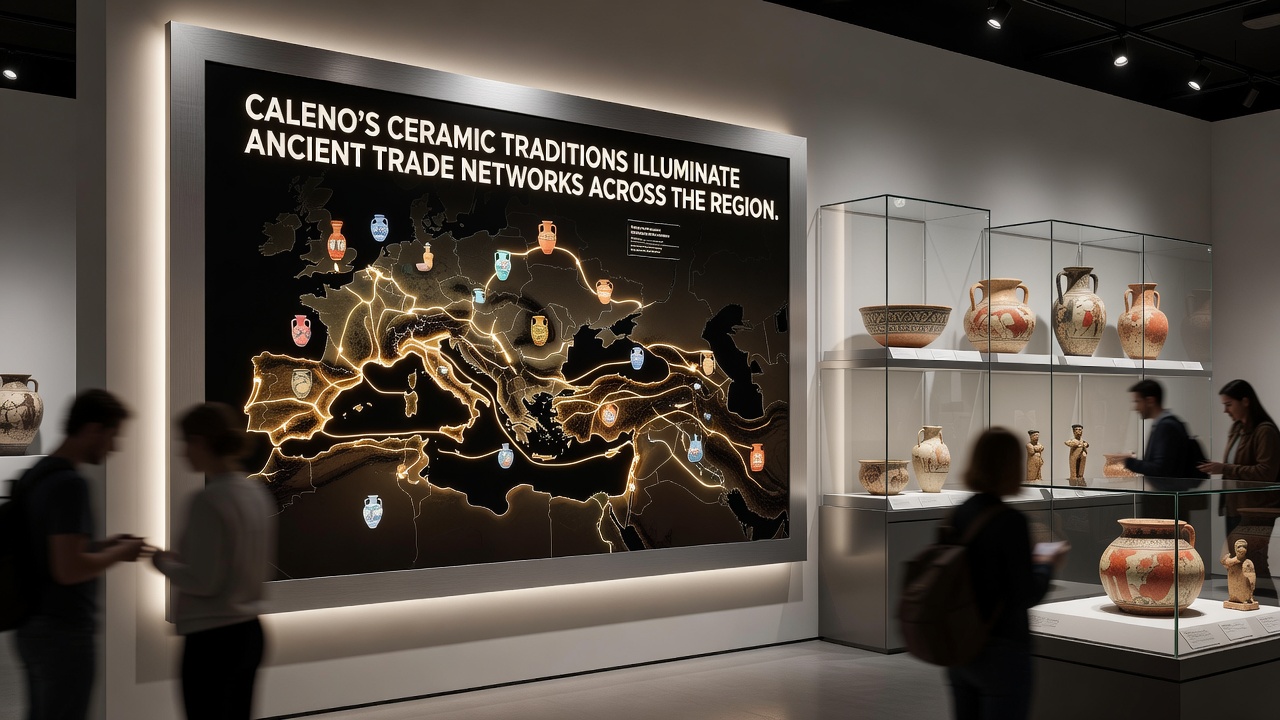
Survey teams have documented clusters of kiln remains positioned at intervals along ancient trackways that connect the central Caleno plain with passes leading to the sea, and the presence of waster piles containing both local and imported clays indicates that some workshops functioned as transshipment points. Geophysical mapping of these trackways reveals consistent alignments with known Bronze Age cairns that may have served as waymarkers, and the same alignments appear on later Roman itineraries, which implies continuity of use over many generations. Faunal remains recovered near the kilns include species whose natural ranges lie outside the immediate region, further supporting the picture of mobile populations who moved goods as well as livestock.
Chronological Refinements and Future Work
Recent thermoluminescence testing on a stratified sequence of wasters has narrowed the primary production window to roughly 1200–800 BCE, and this tighter chronology allows researchers to correlate ceramic peaks with documented shifts in regional climate that would have affected both agriculture and transport. Plans announced for the September 2026 field season include expanded use of portable X-ray fluorescence units to conduct on-site sourcing of newly excavated sherds, which should reduce laboratory turnaround time and permit faster integration of results into regional distribution maps. Archaeological Institute of America reports already incorporate preliminary data from Caleno, and parallel datasets compiled by teams at the Australian National University continue to test whether similar sourcing patterns appear in comparable island environments elsewhere.
Conclusion
The accumulating evidence from ceramic analysis, settlement surveys, and material sourcing demonstrates that Caleno traditions functioned as both products and vectors of extensive ancient trade networks, and ongoing fieldwork scheduled through 2026 promises additional resolution on the timing and scale of these connections. As laboratories and field projects integrate their findings, the outlines of a once-vibrant regional economy become steadily clearer through the durable medium of fired clay.